SHANSIO · LEARN
Flush in Omaha: why one card of suit is not enough
In Omaha, a flush requires exactly two cards of the desired suit from one's own hand and exactly three community cards of that suit. One card of the suit in hand is not suitable even with four on the board.
The 2+3 rule also applies to flushes.
The Omaha High player has four or five hole cards, but exactly two of them end up in the final five. If there are four hearts on the board, but there is only one heart in your hand, you cannot take it along with the four common ones. Such a flush would break the rule. You need to re-find the best permissible combination of a pair of your cards and the board’s three.
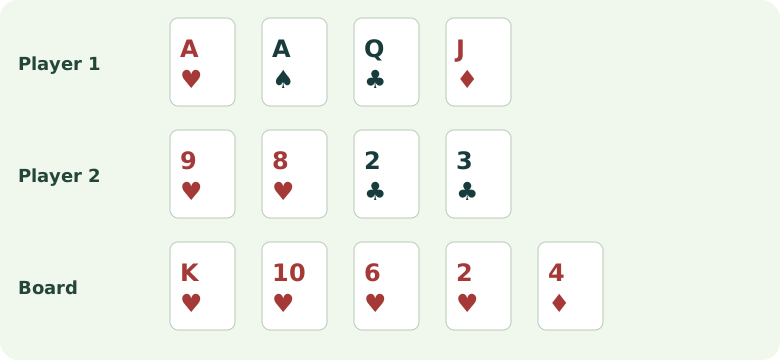
Five hole cards don't change the rule
Omaha High 5 has more pairs of hole cards, but for each five chosen, the rule remains the same. If the fifth card comes the second heart, it can make a flush possible for the first time. Three hearts in your own hand cannot be used at the same time. When comparing two flushes, all five ranks are compared in turn, not just the lowest card or suit.
Common mistake
A common mistake is to assume that one heart in your hand along with four on the board makes a flush. In Hold'em this is possible, but in Omaha such a five would only use one of its own cards. Check the number of your cards taken before the name of the combination. All known cards in one deal must be different. Solve Omaha 4 problem or repeat Omaha 5.
Check both sides of the comparison
Even if one player has two cards of the correct suit, it is not automatically a winning flush. The opponent can also have two cards of the same suit, both of which are higher. First make sure there are at least three cards of suit on the board, then make each player's best legal five. When comparing flushes, they go from the highest rank to the next until the first difference. Suit itself does not provide an advantage.
In Omaha High 5, the fifth hole card increases the number of hand pairs that can be played. It can become the second required card of the suit, but does not allow you to take three hole cards at the same time. It is convenient to test such a trap in an exercise with two exposed hands: analysis will show the origin of each flush card.
Try on other cards
The short selection does not replicate the fully disclosed examples in this article. Select game: Practice the topic: Omaha 4 · Practice the topic: Omaha 5.