SHANSIO · LEARN
Dividing the pot: when the combinations are equal
A tie occurs when the top five legal players have the same total strength. No matching physical cards or suits are required.
Same power, different hands
Two players may have different cards, but the same category and all ranks being compared. If there is complete equality, the pot is divided. Suits are not ranked: the ace of spades is not older than the ace of hearts. Cards remaining outside the top five are also not taken into account.
A strong board in Omaha does not equal board play
In Omaha High, the player must use exactly two of his cards and three community cards. For example, on a board of Q♠ J♥ 10♣ 7♦ 8♣, hands A♠ K♦ 2♣ 3♥ and A♥ K♣ 4♦ 5♠ give the same straight A-K-Q-J-10. This is a tie due to equal strength, not because all five cards are drawn from the board. If one player has a different card instead of a king, the comparison may change.
Common mistake
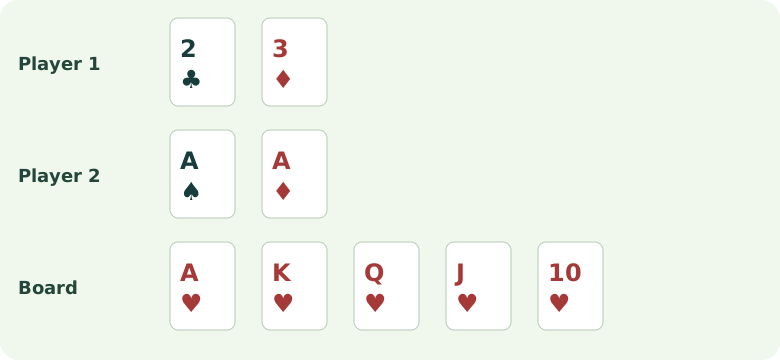
Declare a split just because there is a straight or flush on the board. In Hold'em, your opponent can improve the total straight with his card. In Omaha, both hands generally need a pair of their cards, so a strong board in itself does not determine the outcome. First find the best allowed five for each. Check comparison and repeat the Omaha rule.
Tie and probability of tie
In these examples the outcome is already known because both hands and the entire board are open. In a calculator with an unknown opponent's hand, the split probability refers to the proportion of possible outcomes where someone splits the pot with you; this is not the same value as the pot's expected share, or equity. If two participants have an equal outcome, each player gets half of one pot. If there are more participants, the share depends on the number of winners.
A practical way to test a controversial showdown: separately collect each player's valid top five, name the category, and compare all of its significant ranks. If even the last compared cards match, stop. The color and suit of the cards may vary, but there are no additional rules for suit precedence to determine the winner.
Try on other cards
The short selection does not replicate the fully disclosed examples in this article. Select game: Practice the topic: Hold'em · Practice the topic: Omaha 4 · Practice the topic: Omaha 5.