SHANSIO · LEARN
Outs: Improvement Doesn't Always Win
Out to get ahead makes sense relative to the opponent's specific hand and current position. Improving your combination does not guarantee win; If the player is already ahead, all cards that maintain the lead should not be called outs.
First determine who is ahead
There are four community cards on the turn, and there is one more river ahead. With fully exposed hands, you can find both the best valid fives and the total for each remaining card. If Player 1's hand is currently losing, a winning river actually puts him ahead in this model. If she is already stronger, many winning rivers only maintain their advantage. To call them all “outs” would be inaccurate.
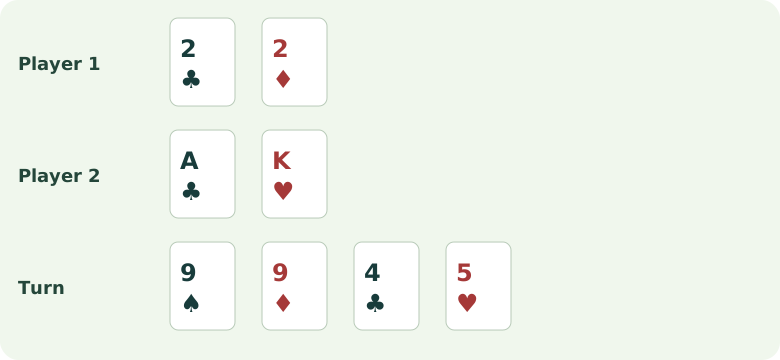
If A♠ comes in the same hand, the opponent has a pair of aces and player 1 loses. This is not an example of player 1 getting ahead.
Win and tie are different
In another open example of T♠ 2♣ against 9♥ 9♦ on a board of A♠ K♥ Q♦ J♣ player 1 already has a high straight. Of the 44 rivers, 41 leave a single win, and three tens give a common high straight and split. These three tens do not count as winning cards in the Find the Winning Rivers exercise.
For an unknown hand, a model is needed
If your opponent's cards are hidden, the exact number of rivers for one open pair of hands cannot simply be carried over to the actual hand: different compatible hands and ranges are possible. The 2 and 4 rule provides only a rough approximation for some plays, not a replacement for the exact denominator of 44, 40, or 38 in a two-handed lab. In Omaha, there is an additional rule of exactly two hand cards and three board cards.
Explore your cards in River's labs or find winning rivers on unsolved hold'em examples. Both deals discussed above are excluded from the first series at this link.