SHANSIO · LEARN
Ace in straight: low and high sequence
An Ace completes a high straight of 10-J-Q-K-A or a low A-2-3-4-5. A sequence going from Ace to Deuce, such as Q-K-A-2-3, is not considered a straight.
The top card of a low straight is a five.
When comparing straights, only the top card of each sequence is important. A-2-3-4-5 is often called a wheel: here the ace plays as a one and is the lowest straight. The sequence 2-3-4-5-6 is higher, although there is no ace in it at all.
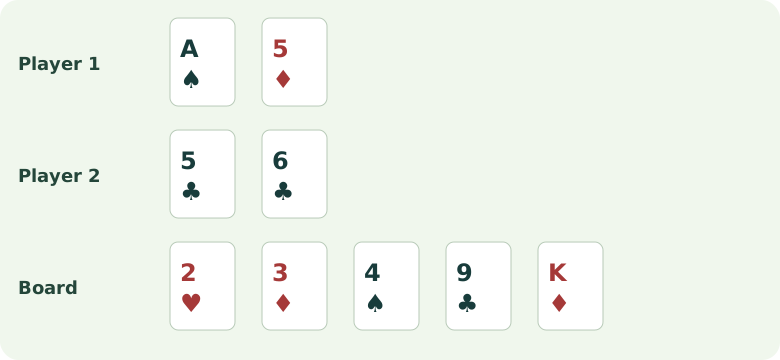
Where the sequence breaks off
Q♠ K♦ A♥ 2♣ 3♥ does not form a straight. An ace cannot simultaneously be higher than a king and lower than a two in the same five. These five cards make up the highest card if there is no pair or other combination. Likewise, A-2-3-4-6 is not a straight: there is no five between the four and the six.
In Omaha, you must additionally comply with 2+3
Even if five consecutive community cards are visible, it is not a made hand in Omaha. Choose exactly two of your cards and three community cards. In one training example, A♥ 2♦ from the hand is connected to 3♣ 4♦ 5♥ from the board for a low straight. If the other player has 7♣ 8♦ and 4♦ 5♥ 6♦ are available from the board, his straight to eight is higher. Compare two hands and research card replacement.
How to quickly check a questionable sequence
Order the five selected values without regard to suits. There must be a step of exactly one value between adjacent cards. The only exception is for an ace on the low straight A-2-3-4-5. The presence of a pair among these five cards does not create a straight: a repeat of rank takes the place of a card that may not be enough for the sequence. If several straights can be made from the available cards, take into account the highest one allowed.
Comparing A-2-3-4-5 versus 2-3-4-5-6 does not come down to the presence of an ace. The top cards of these straights are five and six, so the second one wins. In Omaha, first select the legal two hand cards and three board cards; only then apply consistency checking. Otherwise, you can accidentally call a straight, which requires three hole cards. This rule does not depend on the suit of the ace or the order in which the cards were dealt on the board.
Try on other cards
The short selection does not replicate the fully disclosed examples in this article. Select game: Practice the topic: Hold'em · Practice the topic: Omaha 4 · Practice the topic: Omaha 5.